
Interior Iron Railings in Marietta
National Ironwork is a family-owned Marietta shop that builds custom iron railings in-house and provides a 5-year warranty on all welds and installation; powder coating not covered; not transferable.
- Family-owned and operated
- General liability insured
- 5-year warranty on all welds and installation
- Free estimates
Signs Your Staircase Needs New Iron Railings
A railing that moves when you lean on it is telling you the anchor points have failed, not the metal. Any one of them means the railing needs hands on it now.
Nine times out of ten it’s the same thing. The anchors were set into wood treads that have dried out and shrunk over the years, and now the screws are just spinning in oversized holes. We see this constantly in the older split-levels and ranches around Marietta where the original builder-grade wood balusters got swapped to iron by a previous owner without redoing the anchor points.
- Rust staining or bubbling paint at the base of a post, which usually means water has been sitting where the metal meets the floor
- A hairline crack or gap at a weld joint, especially where a baluster meets the handrail
- Balusters you can spin or rattle by hand
- Gaps between balusters wider than about four inches, which is an old-code layout that won’t pass an inspection today
- A handrail that has pulled away from its wall bracket and left a crescent-shaped hole in the drywall
If a 200-pound adult can make it move, it won’t stop a falling one.
Some of this is repairable. A single cracked weld or one loose post can often be fixed in place, and we do on-site repairs with a $450 minimum. But when the rust has eaten through a post from the inside, or the spacing is wrong along the entire run, patching it is throwing money at a railing that’s already done. That’s the point where new fabrication costs less over five years than the repairs will.
Custom Fabrication Versus Stock Railing Kits
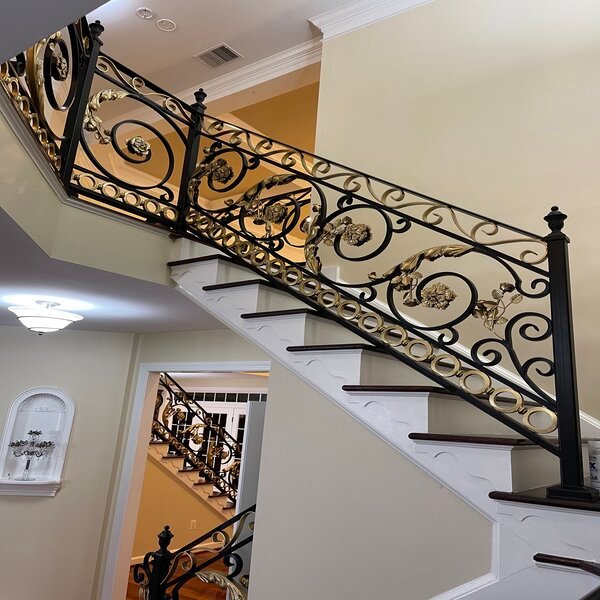
Stock kits exist for a reason. They’re cheap, they ship fast, and on a straight run of stairs with square walls, they can look fine. If your staircase is a plain 12-step straight shot in a newer subdivision, and you like the look of the kit in the photo, buy the kit. We’d rather tell you that than sell you something you didn’t need.
Here’s where kits fall apart. They assume your house is square. Most aren’t.
A lot of the older homes around Marietta sit on stairs that were framed by hand, and the rise from tread to tread can vary by a quarter inch or more across a single run. A stock kit has fixed bracket spacing. When the stairs wander, the brackets land in the wrong spot, and you end up with shims, filled holes, and a rail that reads crooked from across the room. Custom fabrication starts with measuring your actual stairs, not a catalog drawing.
A few things push people toward custom work:
- Curved, winding, or split staircases where no straight section runs more than a few feet
- Open landings and balcony edges that need a guard, not just a grab rail
- Ceiling heights or stair widths that fall outside standard kit sizes
- A specific design you already have in your head, like flat bar pickets or a hammered texture
- Old ironwork you want matched instead of replaced whole
What Determines the Cost of Interior Iron Railings
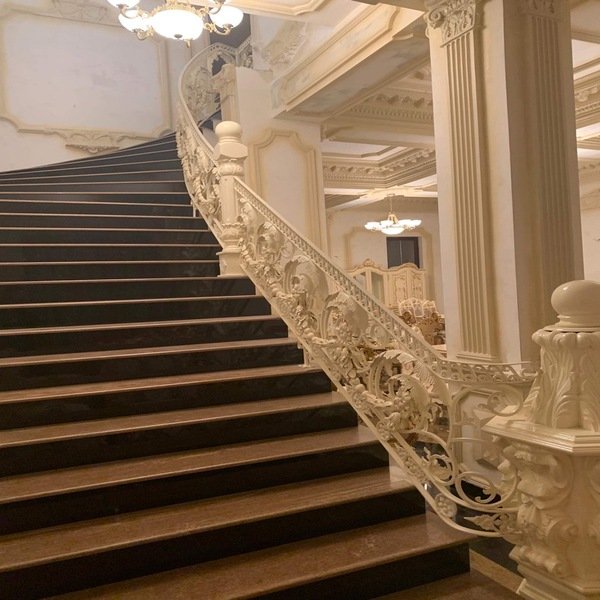
Interior iron railings get priced by the linear foot in most shops, then adjusted. The adjustments are where the real money moves. A straight run along a landing is the cheapest foot of railing you’ll ever buy. On a curved stair with a volute at the bottom and a winder turn halfway up, every picket is a different length and every one gets cut and welded by hand. Same house, same material, triple the labor.
- Straight runs are fast. Curves, winders, and balcony returns are slow.
- Picket count and spacing. Code spacing means more pickets on a long run, and each one is a weld.
- Design work. Plain square bar costs less than scrolls, baskets, or hammered texture.
- Hand-brushed oil-rubbed finishes take shop time that powder coating doesn’t.
- Mounting surface. Anchoring into oak treads is quick. Tile, stone, or a slab landing is not.
- Tear-out. Pulling old wood balusters and patching the holes is its own line item.
Frequently Asked Questions
What happens during a railing estimate visit?
We walk your staircase, check anchor points, and test how much the railing moves under pressure, the same push test you can do yourself. We measure your rise, your run, and your newel locations, and we check what’s under the floor at every post point. Estimates are free, so you get a clear answer on repair versus replacement before spending anything.
How long does an interior railing install take?
A straight-run interior railing is usually a one-day install. Curved stairs, landings, and open balcony runs take longer. Most of the calendar time is shop fabrication before we arrive. We tape and cover the treads and cut outside when we can, but grinding sparks and metal dust are real. Kids and pets upstairs for the day is the easy answer.
Do I have to replace my railing if I just don't like how it looks?
No. If your railing is solid and you just don’t love the look, wait. Surface rust or a chipped finish with no pitting means refinish, not replace. Paint it and live with it another season. Redoing a staircase railing you don’t need is money you could put somewhere that matters more.
Ready to Create Something Beautiful?
Let's bring your ironwork vision to life. Whether it's a small residential detail or a large commercial installation, National Ironworks is ready to deliver exceptional craftsmanship and timeless design.