
Custom Gates in Marietta
National Ironwork is a family-owned Marietta shop that builds custom iron railings in-house and provides a 5-year warranty on all welds and installation; powder coating not covered; not transferable.
- Family-owned and operated
- General liability insured
- 5-year warranty on all welds and installation
- Free estimates
Signs Your Property Needs a Custom-Built Gate
Most people need a custom gate because their opening isn’t square, level, or standard. Sloped driveways, settled brick columns, and openings wider than 12 feet all put a stock gate out of the running. If your gate drags, gaps at one corner, or won’t latch without a shove, the problem is usually fit, not hardware.
Look at the bottom of your gate where it swings. On a lot of Marietta driveways the gap isn’t even, because the grade drops off toward the street to move water away from the house. A gate built flat will scrape on the high side and leave a six inch gap on the low side. That’s a gate built for the wrong opening.
The other big one is column movement. Brick or stone columns set without a deep footing lean a little as the clay shifts, and once the posts have moved, no off-the-shelf gate is going to close right.
Two more signs to check:
- Welds are cracked at the corners and the frame has gone out of square
- You want the gate to match existing wrought iron fencing or railings on the property
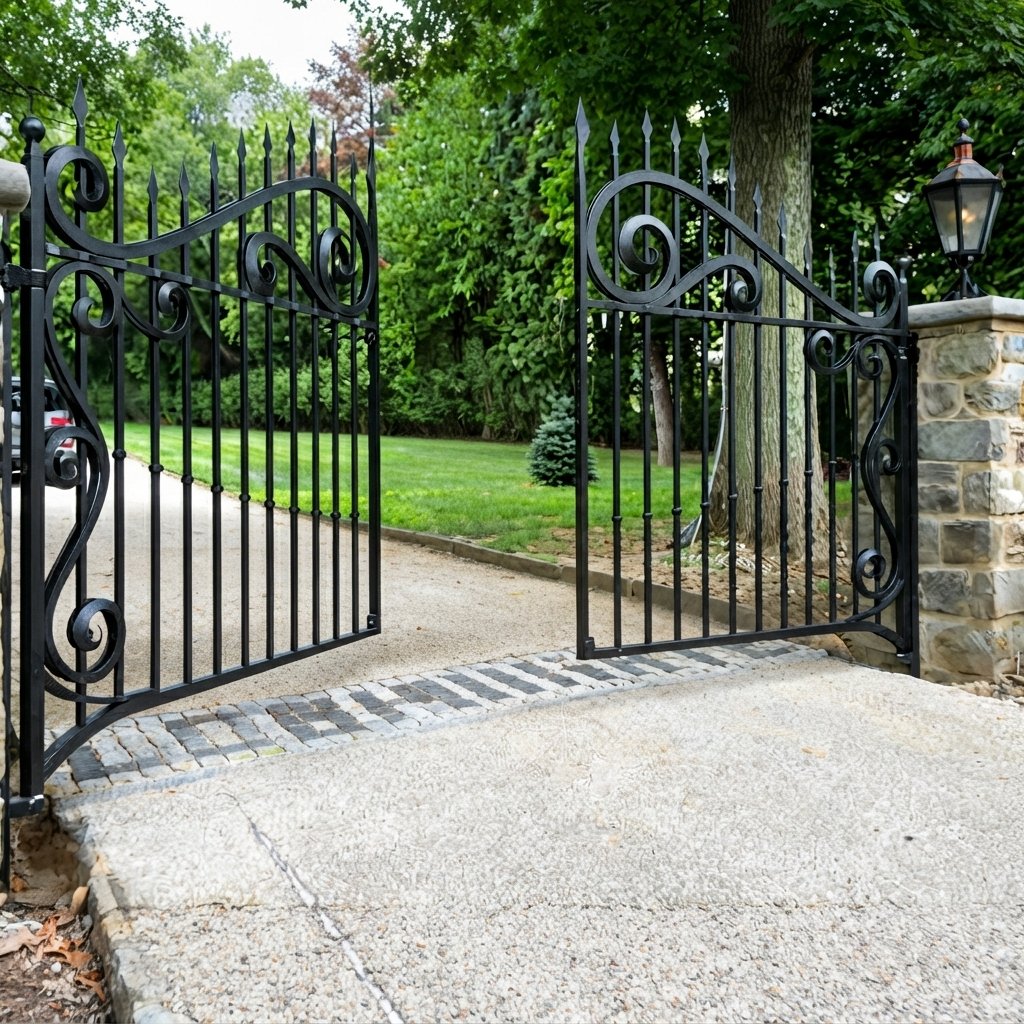
How a Custom Gate Comes Together, Start to Finish
Most folks think the hard part is the welding. It isn’t. The hard part is measuring a driveway that isn’t level and figuring out how a gate is going to swing across it without dragging in year two. A lot of the older driveways off Roswell Road pitch toward the street for drainage, and that pitch decides everything about how we build the frame and hang the hinges.
- We come out and look. Free on-site estimate. We measure the opening, check the slope, look at your posts or figure out where new ones go, and ask how you want it to open.
- We talk design. Pickets, panels, scrollwork, a solid privacy face, spear tops. This is also where you tell us if an automatic opener is coming later, because that changes the weight we build to.
- You approve the drawing and the number. Nothing gets cut until you say yes.
- We fabricate in the shop. Steel gets cut, fit, welded, and ground clean. Doing it indoors means better welds than anything built in your driveway.
- Finish goes on. Every gate gets a powder-coated finish.
- We set posts and hang it. Concrete footings for the posts, then we hang the gate, set the swing, and adjust the latch.
Between approval and install you’re usually waiting a couple of weeks. Fabrication takes time, and the finish has to cure. We’d rather tell you three weeks and hit it than promise one and make you chase us. One thing people are surprised by: we care more about your posts than your pickets. A beautiful gate on a weak post sags. Every time.
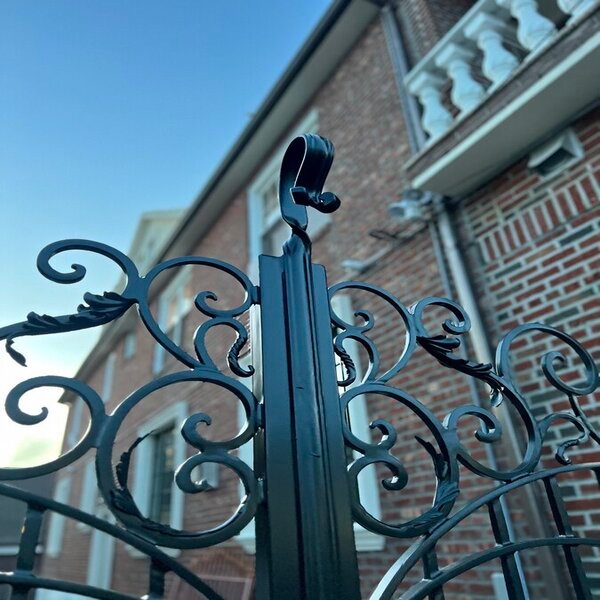
What Drives Custom Gate Pricing
Every custom gate gets priced from scratch, not off a list. Three things drive the number: how much steel goes into it, how many hours it takes to build, and what the site demands. A 10-foot walk gate and a 16-foot double driveway gate might use the same design, but one takes twice the material and needs heavier posts set deeper. That’s not upselling, that’s physics. A wide leaf sags if the frame and hinge posts aren’t sized for it.
- Span and height. Wider and taller means heavier stock, bigger posts, more concrete.
- Design complexity. Straight pickets weld fast. Scrollwork, cast pieces, and curved top rails are all hand labor.
- Adding an operator means a gate hinged and balanced for a motor, plus power run to the post.
Site conditions surprise folks the most. Slope, rock, tree roots, and existing footings all change the install day. A lot of Marietta driveways run uphill off the street, and a swing gate on a grade needs either a rising hinge or a redesigned bottom rail. Our red clay holds water too, so hinge post footings usually go deeper here than a flat sandy lot would need.
If you’re weighing a single gate against a full run of iron fences and gates around the property, the math changes when posts get shared.
Frequently Asked Questions
My gate drags on the driveway. Do I need a new one?
Often not. A lot of gates need a post reset, not replacing. Georgia red clay swells when it’s soaked and shrinks when it bakes, and a footing that wasn’t dug deep enough tilts a little more every season. If the frame is square and the welds are solid, repair almost always wins. A rusted-through bottom rail or pulled-apart corners mean replacement.
Is there a minimum charge for gate repairs?
Yes. On-site repairs carry a $450 minimum, because a truck, a welder, and a crew go out regardless of how small the fix is. If your gate still works and the rust hasn’t started flaking, sanding and repainting it yourself buys you years. Don’t pay anybody to fix a gate that isn’t broken. We work in iron only, not wood, chain link, or vinyl.
Do I need a permit for a gate in Cobb County?
A plain swing gate on a fence line usually doesn’t turn into a big permit conversation. Adding a motor, running power, or putting the gate near a pool changes that, since pool barriers have their own height and gap requirements. Call the Cobb County permitting office before you settle on a design, and check your HOA covenants for height and style rules.
Ready to Create Something Beautiful?
Let's bring your ironwork vision to life. Whether it's a small residential detail or a large commercial installation, National Ironworks is ready to deliver exceptional craftsmanship and timeless design.