
Structural Steel in Marietta
National Iron Works is a family-owned Marietta shop that builds custom ironwork in-house. Welds and installation carry a 5-year warranty (powder coating not covered; not transferable).
- Family-owned and operated
- General liability insured
- 5-year warranty on all welds and installation
- Free estimates
Structural Steel vs. Ornamental Ironwork: Know the Difference
Here’s the simplest test. Ask yourself: if this piece of metal went away, would something above it drop? If the answer is yes, it’s structural. If the answer is no, and it’s mostly there for looks, safety, or security, it’s ornamental.
- Structural steel: beams that hold up a floor or roof, steel posts and columns, lintels over a wide opening, a beam that replaces a wall you want to take out, or framing that carries a deck or balcony.
- Ornamental ironwork: railings, gates, fences, decorative scrollwork, and window guards. These need to be strong and well made, but they don’t hold up the house.
We do both kinds of work at National Iron Works. If your project leans decorative, our pages on Ornamental Ironwork, Custom Gates, Wrought Iron Fencing, and Balcony Railings cover those in detail. If it’s damaged metal that just needs fixing, Welding Repair or Railing Repair may be the better fit. And if you can’t tell which bucket you’re in, that’s fine. Describe what the metal is holding up and where it sits, and that usually sorts it out fast.
Signs a Repair Is Truly Structural
Most damage to steel shows up in the house around it before you notice it in the metal. When a beam, post, or lintel starts losing strength, the parts it holds up start to move. So the first clues are often in your walls, floors, and doors, not on the steel.
These are the signs that point to a structural problem:
- A floor that sags, dips toward the middle of a room, or bounces more than it used to when you walk across it.
- Cracks in brick or drywall that run at an angle out from the corners of a window, door, or garage opening. That can mean the lintel above the opening is bending.
- Doors or windows that used to work fine and now stick, rub, or won’t latch.
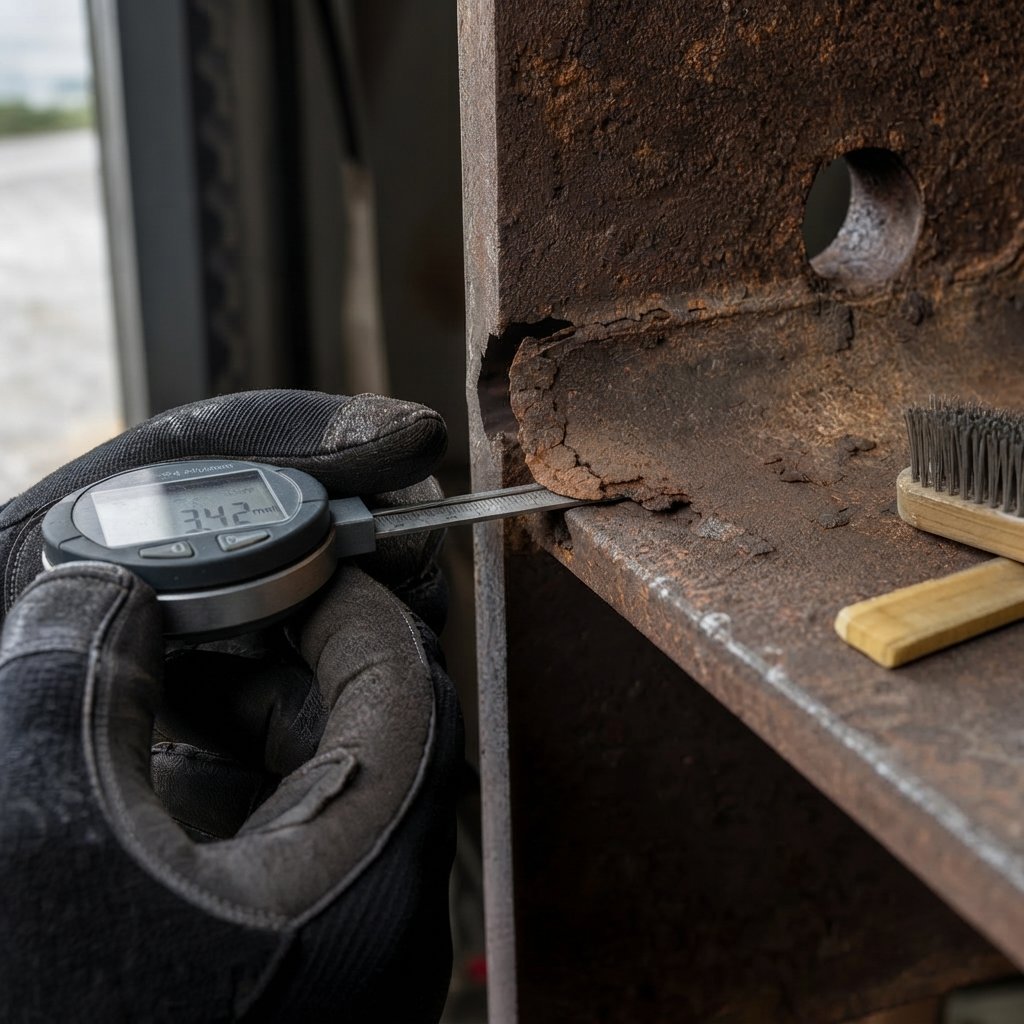
- Rust that has turned into thick flakes or layers, or that has eaten away enough metal to leave the steel visibly thinner, pitted, or holed.
- Rust or swelling right where a post meets its base plate or the concrete, since that’s where water sits and where the load ends up.
- A crack in a weld, or a weld that has pulled away from the steel at a connection.
- Bolts that are loose, bent, sheared off, or missing at a beam or column joint.
- A beam that looks bowed or twisted when you sight down its length.
- Deck or balcony framing that’s pulling away from the house, or a gap that keeps getting wider between the frame and the wall.
A repair starts with a look at the steel and what it’s holding up. At National Iron Works, Matt handles the calls, estimates, and scheduling, so the person you talk to on the phone is the same person who comes out to see the problem. The goal of that first visit is to answer three questions: how much good metal is left, what the steel is carrying, and whether the real cause is something else, like water or a bad footing. Fabrication is overseen by Matt’s father, who owns and runs the business.
If you’re not sure, take a few photos before you call. Get a wide shot of the room or opening and a close-up of the metal, plus any cracks you’ve noticed. Our estimates are free, and for repairs that need us on-site, our minimum is $450. Photos help us figure out what kind of visit makes sense.
Structural steel is part of our metal fabrication work.
Ready when you are – get in touch today. Call for a free estimate. National Iron Works is ready to help. (770) 309-6681
Frequently Asked Questions
Can I stay in my house while a structural steel repair is being done?
Yes, most families stay home during the repair, but you’ll want to clear the work area first. If the post or beam is in a garage or basement, move boxes and anything flammable away, since cutting and welding throw sparks. Pets and kids are usually happier in another part of the house while the hot work is happening.
How do I know if a crack in my wall is serious or just normal settling?
A single hairline crack by itself is often just normal settling and fine to watch. It becomes worth a closer look when it shows up alongside other signs, like a door that now sticks, a sagging floor, or heavy rust on a nearby post. When several signs point the same direction, that combination is the real warning, not one crack alone.
Do I need a permit for a structural steel repair in Marietta?
If the steel holds up part of your house, plan on asking about a permit before work starts. Replacing a beam, column, or post that carries a floor or roof often needs one. A Marietta mailing address doesn’t always mean you’re inside Marietta city limits. Many homes sit in unincorporated Cobb County, and the county runs its own permit office. Your property tax bill is an easy place to check.
When is it not a structural steel job?
When the problem is in wood framing, in the concrete footing under a post, or in drainage that keeps the steel wet. A carpenter, a foundation contractor, or a drainage fix comes first in those cases. If the steel is solid and the only issue is how it looks, a wire brush and the right primer may be all you need. Calling the right trade first saves you money.